
Verifying Tirzepatide Purity: How to Read HPLC and Mass Spectrometry Reports Before You Trust the Label
A tirzepatide lab report can confirm two separate things: how pure the sample is (HPLC) and whether it’s actually tirzepatide (mass spectrometry). If you’re comparing research-grade peptide listings, such as https://kylopeptides.com/product/glp-2-tz/ you need both, and a report that shows only one tells you half the story. Reading it takes about ten minutes once you know what to look for: a clear purity percentage with a clean, dominant peak, a measured molecular weight that matches tirzepatide’s expected value, and details that tie the report to a specific batch, lab, and date.
The report is often the only evidence of quality you’ll see, which is why it pays to read it critically.
Think of it like checking a solar installer’s licence. A glossy brochure means little until you confirm the credentials behind it. A lab report works the same way: it can look official while proving very little. Pages can be edited, reused across batches, or issued by labs you can’t verify.
This guide walks through each chart and number in plain English, then gives you a practical trust checklist. It also covers what even a genuine report can’t tell you about safety, dosing, or sterility. For anything you plan to take, a licensed provider and a regulated pharmacy remain the only reliable route.
Why Purity Testing Matters Before You Trust a Vial
When a product arrives in a vial with no pharmacy label and no regulator behind it, the label is just a claim. Testing is one of the few ways to check that claim, and several things can go wrong when nobody has.
The dose could be off. A vial might hold far less or far more than the number printed on it, and with a potent medication, that gap matters. The vial could also contain contaminants left over from manufacturing or introduced through poor handling. Peptides are delicate, too. Heat, light, and time can break them down, so a product that started out fine may no longer be what you think it is. In the worst case, the vial holds an entirely different substance than the one on the label.
Tirzepatide is a prescription drug. The safest way to get it is through a licensed pharmacy or the manufacturer, where regulators oversee quality control long before a dose reaches you. A lab report from an unregulated source can’t replace that oversight, and it can’t replace a prescription or a clinician who knows your health history.
What a report can do is help you ask sharper questions. Who ran the test? Does the batch number match your vial? Does the document hold up when you look closely? Think of it as reading the fine print rather than getting a stamp of approval.
Homeowners do something similar with solar. Before signing, they check an installer’s certifications and compare panel specs against the paperwork, because a confident sales pitch isn’t proof. Verification works the same way here: look at the evidence, and treat anything you can’t confirm with caution.
Purity vs. Identity: The Two Questions Every Lab Report Tries to Answer
Every credible lab report is really trying to answer two separate questions, and they need two different tests. The first: how pure is this sample? The second: is the main ingredient actually tirzepatide?
Think of a sealed box that’s 99% full of one substance. That sounds reassuring until you realize nobody has told you what the substance is. The reverse is just as unhelpful. Knowing the box contains tirzepatide means little if a lot of other material is mixed in. You need both facts before the report tells you anything useful.
HPLC speaks to the first question. Mass spectrometry speaks to the second. Here’s how they line up:
| HPLC | Mass spectrometry |
|---|---|
| Question it answers: How pure is the sample? | Question it answers: Is the main substance tirzepatide? |
| What it measures: How much of what was detected is the main component, versus other substances | What it measures: The molecular weight of the main component |
| What it cannot tell you: What the main substance actually is | What it cannot tell you: How much of the sample is that substance, compared with everything else |
Seeing them side by side makes the point clear. Each test covers the other’s blind spot, which is why a report with only one of them is incomplete.
Understanding HPLC Reports Step by Step
What an HPLC Chromatogram Actually Shows
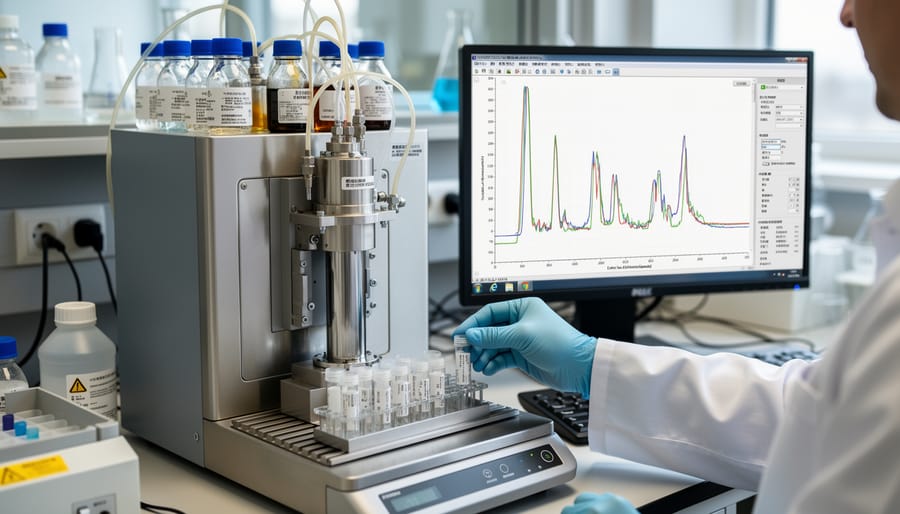
An HPLC chromatogram is a line graph, and once you know its four parts, it stops looking like static. Time runs along the bottom. The strength of the detector’s signal runs up the side. As the sample moves through the column, each substance in it comes out at a slightly different moment, and the detector draws a bump every time one does.
Here are the terms you’ll see on most reports:
- Chromatogram
- The full chart the instrument produces, showing detector signal plotted against time.
- Peak
- A bump on the chart. Each peak represents a different substance leaving the column.
- Retention time
- How many minutes a substance takes to travel through the column. It’s printed above or beside each peak.
- Baseline
- The flat line the trace rests on when nothing is coming off the column.
- Reference standard
- A verified sample of the real compound, run under the same conditions, so its peak can be used for comparison.
A clean report shows one tall, narrow main peak at the expected retention time, with a steady baseline and only a few tiny bumps beside it. Those small side peaks are other substances in the vial, such as leftover manufacturing by-products or slightly altered forms of the molecule. Fewer and smaller side peaks generally point to higher purity.
Be wary of a messy baseline, a wide or lumpy main peak, or a retention time that was never compared to a reference standard. Without that comparison, the chart tells you something is in the vial, but not that it’s tirzepatide.
How to Read the Purity Percentage
The purity percentage is the number most people jump to, and it’s easy to misread. In most HPLC reports, it’s calculated by taking the area under the main peak and dividing it by the combined area of all the peaks the detector picked up. If the main peak accounts for 98% of that total area, the report calls the sample 98% pure.
That figure describes relative purity: how much of what the instrument detected is the main compound. It says nothing about how much tirzepatide is actually in the vial. A vial could show a very high purity percentage and still hold far less drug than the label claims, because the calculation only compares peaks to each other, not to a known amount.
That’s the difference between purity and content, sometimes called potency or assay. Content answers a different question: how many milligrams are really in there? Verifying it takes a separate test that compares the sample against a reference standard of known concentration. If a report gives only a purity percentage and no content result, you’ve learned half the story at most.
It also helps to know that acceptable purity thresholds depend on the intended use and the standard being applied. Pharmaceutical-grade standards differ from research-grade ones, so a number only means something once you know what it’s being measured against. Be cautious of any report that treats one percentage as a universal pass mark.
Limits of HPLC: What It Can Miss
A clean HPLC chart is reassuring, but it only answers one narrow question: how much of what the detector saw is a single dominant compound. It says nothing about what that compound is. A peak that shows up at a certain retention time looks like tirzepatide only if someone ran a genuine reference standard under the same conditions and the times line up. Without that comparison, the peak is just a peak.
HPLC also sees only what it’s built to see. The method, including the column, the solvent mix, and the detector settings, determines which impurities show up. Things like bacterial endotoxins, microbes, residual solvents, and heavy metals generally need their own dedicated tests. If the report doesn’t list those tests, assume they weren’t done.
Here’s what an HPLC purity result generally does not confirm:
- The identity of the main compound
- Sterility of the product
- Endotoxin levels
- The exact dose or amount per vial
- How well the product holds up in storage over time
Think of it like a solar panel’s efficiency rating. It’s a useful number, but it doesn’t tell you whether the panel is safely wired or built to last on your roof. In the same way, an impressive purity figure is one piece of evidence, never the whole picture, and it works best alongside identity testing and clear documentation.
What Mass Spectrometry Adds to the Picture
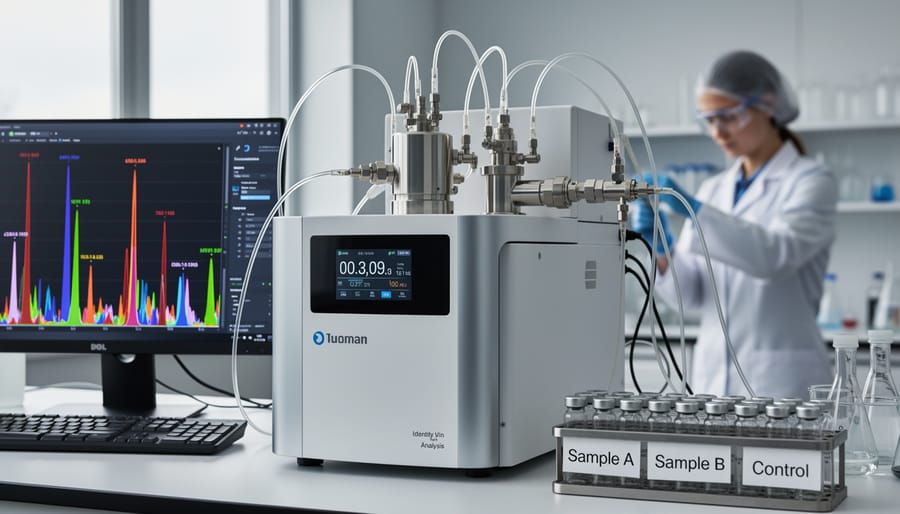
Think of mass spectrometry as an extremely precise scale for molecules. A liquid chromatography test like HPLC tells you how many different things are in the sample. Mass spectrometry tells you what the main thing weighs, and weight is a strong fingerprint. Every molecule has a specific molecular weight, measured in daltons (Da), and tirzepatide’s is a published, well-documented figure.
Here is how it works in plain terms. The instrument gives the molecules in your sample an electrical charge, then measures how they move. The result is a spectrum, a chart with mass on the horizontal axis and signal strength on the vertical axis. If the vial really contains tirzepatide, you should see a strong peak at the expected mass.
There’s a wrinkle that trips people up. Large molecules like tirzepatide often pick up several charges, so the chart may show a series of peaks at different positions instead of one tidy spike. That’s normal. A competent lab will include a “deconvoluted” result, which is simply the math that converts that pattern back into a single molecular weight. You want that final number to land very close to the expected value, within a small margin.
That’s the key step for you as a reader: compare the reported weight against a published reference, such as the manufacturer’s labeling or a recognized chemical database. Don’t just accept the lab’s statement that it “matches.” Look up the figure yourself.
Mass spectrometry and HPLC work best as a pair. HPLC says the sample is mostly one substance. Mass spec says that substance has the right weight. Neither one alone closes the loop. Mass spec also isn’t a purity test on its own, since small contaminants can hide beneath a big peak.
Finally, check that the report names the instrument and method used. Specifics like the type of mass spectrometer and how the sample was prepared show the lab is willing to be checked. Vague reports with no method details deserve skepticism. It’s the same habit that makes sense when you’re hiring a solar contractor: look at how they balance quality and service and ask about the service quality dimensions that matter, rather than trusting a glossy brochure. Transparent details are what let you verify a claim.
A Checklist for Spotting a Trustworthy (or Questionable) Report
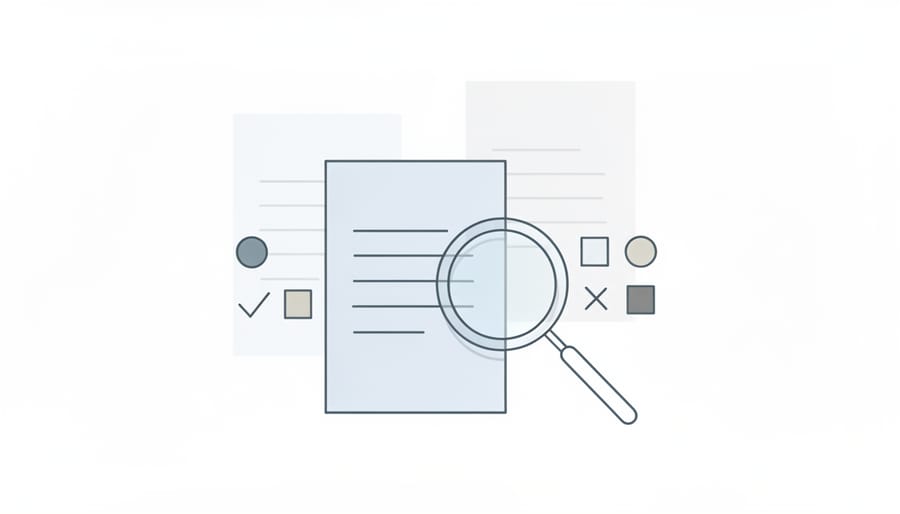
A lab report is only as good as the paperwork behind it, so start by checking the document itself. Work through these questions before you give any weight to the numbers.
What a trustworthy report usually shows
1. An independent lab is named, with a real address, phone number or email. “Independent” means the lab isn’t owned by the seller. Look for a stated accreditation, such as ISO/IEC 17025, and confirm it with the accrediting body rather than trusting a logo.
2. The batch or lot number matches the one printed on your vial. If the numbers differ, the report describes a different product.
3. A test date appears. Old results say little about the vial in your hands today, especially for a peptide that can degrade.
4. The method is described, including the instrument, column, and what reference standard was used.
5. Both raw outputs are included: the HPLC chromatogram and the mass spectrum. A summary table with a neat percentage isn’t enough, because you can’t see what’s behind it.
6. The sample is clearly identified, including how it was received and what it was labeled.
7. A named analyst or reviewer has signed it.
8. Most important, you can reach the lab yourself and ask whether they issued this exact report. Use contact details you find independently, not only the ones printed on the document.
Red flags
– Cropped or low-resolution images that hide axes, headers, or baselines
– No batch number, or one that’s handwritten or vague
– Reports hosted only on the seller’s own website
– A claim of exactly 100% purity, which real-world samples rarely deliver
– Only one of the two tests, or a spectrum with no stated expected mass
– Generic templates with no lab details, dates, or signatures
– Pressure to “just trust” the result without letting you contact the lab
Think of it like verifying a solar panel’s certification. A sticker saying “certified” means little until you check the issuing body and the serial number.
One caution applies to everything above: if you can’t verify a report, treat it as unverified. A polished document that fails these checks should lower your confidence, not raise it. And even a flawless report can’t confirm a product is safe to inject. That’s why a licensed provider and a regulated pharmacy remain the safest route.
Common Questions About Tirzepatide Lab Reports
Readers usually have the same handful of worries once a report is in hand, so here are straight answers to the most common ones.
Can I rely on a report supplied by the seller?
Treat it with caution. A report the seller hosts or produces can’t be checked independently, and cropped images or missing batch numbers are warning signs. The most useful reports come from an accredited third-party lab that you can contact directly to confirm the document is real.
What is a certificate of analysis?
It’s a summary document that lists the tests run on a specific batch and the results, such as purity and identity. It’s only as trustworthy as the lab behind it, and a summary table alone, without the actual chromatogram and spectrum, tells you very little.
Does a good report mean the product is safe to inject?
No. Purity and identity tests don’t cover everything that matters for an injectable, such as sterility or endotoxins, unless those are tested specifically. A clean report is one piece of information, not a safety guarantee.
Why don’t licensed pharmacies hand out HPLC charts?
Because regulators and manufacturers already handle quality control through established standards, so the testing happens before the product ever reaches you. If you have questions about a prescription, your pharmacist can answer them.
Where can I get tirzepatide safely?
Through a licensed healthcare provider who prescribes it and a regulated pharmacy that dispenses it. That route gives you medical supervision and quality oversight that no lab report from an unregulated source can replace.
If a seller pressures you to skip these steps or discourages you from checking the report with the lab, that tells you plenty. The same goes for a solar installer who gets defensive when you ask to see their certifications. A trustworthy provider welcomes the questions, and answering them is part of earning your confidence.
To sum it up: HPLC tells you how pure a sample looks, and mass spectrometry tells you whether the main substance is what the label claims. Each answers a different question, and even together they can’t prove a product is safe to inject. A clean chart doesn’t replace sterility testing, proper dosing, or the oversight of someone who knows your health history.
That’s why the most reliable path is working with a licensed healthcare provider and filling prescriptions through a regulated pharmacy, where quality control happens before anything reaches you. Use lab reports to ask sharper questions, not to talk yourself into a risky shortcut.
The same habit pays off everywhere. Whether you’re choosing a medication or a solar installer, check the credentials, read the paperwork, and pick people you can trust. And when you’re ready to explore how solar could lower your energy bills, Sun Power Solutions is happy to answer your questions, no pressure.
